Book Review: Atlas of AI by Kate Crawford
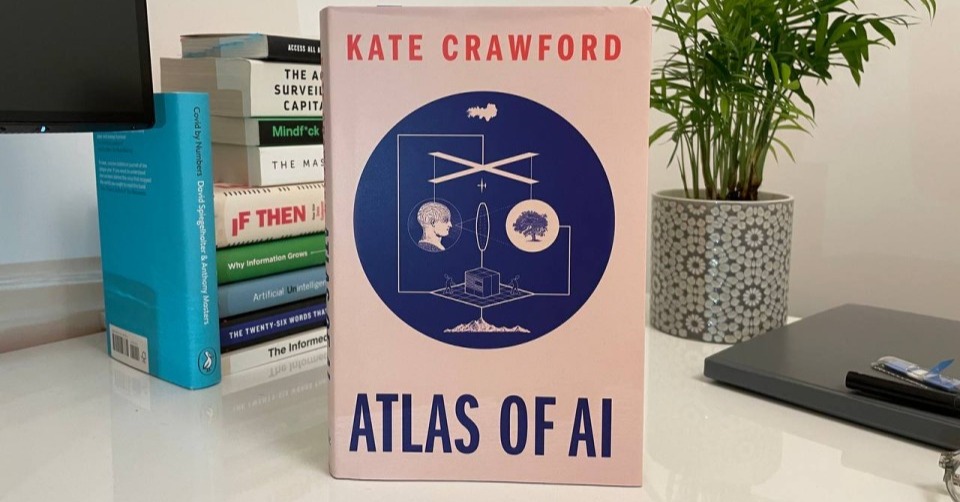
Atlas of AI by Kate Crawford
Rating: 8.5/10
During an Ethical Leadership class in France, I found myself deep in conversation with the professor about the moral dilemmas tied to artificial intelligence. He listened, nodded, and without warning, dashed out of the room. Minutes later, he returned with a book in hand, eyes bright: Atlas of AI by Kate Crawford. “This is where you begin,” he said.
That moment marked the start of a journey that stretched from the lithium mines of Nevada to the commercial dreams of space billionaires. Crawford’s work doesn’t offer the comfort of a tech utopia, it offers a map. A sobering, urgent, deeply researched map of how AI is built, what it consumes, and who it leaves behind.
A Chapter-by-Chapter Reflection
In Atlas of AI, Kate Crawford dismantles the illusion that artificial intelligence is an ethereal, immaterial force. She asserts, “Artificial intelligence is neither artificial nor intelligent. Rather, artificial intelligence is both embodied and material, made from natural resources, fuel, human labor, infrastructures, logistics, histories, and classifications” . This perspective is vividly illustrated in the opening chapter, “Earth,” where Crawford exposes the environmental toll of AI, highlighting the extraction of minerals like lithium and cobalt, essential for powering data centers and devices. She emphasizes that “each object in the extended network of an AI system… is built using elements that require billions of years to form inside the earth”. This chapter compelled me to reconsider the physical and ecological footprint of technologies often perceived as ‘clean’ or ‘virtual’.
Transitioning to the human dimension, the “Labor” chapter unveils the often-overlooked human toil underpinning AI systems. Crawford notes, “Coordinating the actions of humans with the repetitive motions of robots and line machinery has always involved a controlling of bodies in space and time” . This examination of labor dynamics, from data annotators to warehouse workers, reveals how AI perpetuates exploitative labor practices under the guise of automation. It made me reflect on the hidden workforce enabling our digital conveniences.The exploration of data in the subsequent chapter challenges the notion of data as a neutral resource. Crawford argues that AI systems are “trained on datasets shaped by human prejudices, yet are frequently deployed as infallible arbiters of truth”. This chapter illuminated the ethical implications of data collection and usage, prompting me to question the fairness and objectivity of AI-driven decisions.
Building upon this, the “Classification” chapter critiques the categorization inherent in AI systems, which often mirrors and magnifies existing social hierarchies. Crawford observes, “One central thing AI systems do is classify; they fit new examples into old patterns”. The discussion on classification made me aware of how AI can entrench discriminatory practices under the guise of efficiency. In “Affect,” Crawford scrutinizes emotion recognition technologies, questioning their scientific validity and ethical ramifications. She highlights the risks of deploying such systems in sensitive contexts like hiring or law enforcement, where misinterpretations can have serious consequences. This chapter made me skeptical of claims that AI can accurately read human emotions, considering the complexity and subjectivity involved.
The “State” chapter explores the intersection of AI and state power, particularly in surveillance and policing. Crawford discusses how AI tools are used to monitor populations, often disproportionately affecting marginalized communities. The insights here raised concerns about the erosion of privacy and civil liberties in the name of security and efficiency. Examining the concentration of power among tech giants, the “Power” chapter reveals how AI serves to reinforce existing hierarchies. Crawford contends, “To suggest that we democratize AI to reduce asymmetries of power is a little like arguing for democratizing weapons manufacturing in the service of peace”. This perspective challenged my views on technological democratization, highlighting the complexities involved in redistributing power in the digital age.
In the final chapter, “Space,” Crawford discusses the ambitions of tech billionaires to colonize space, drawing parallels to historical patterns of exploitation. She critiques the privatization of space exploration, warning against repeating colonial mistakes on a cosmic scale. This chapter broadened my understanding of AI’s implications, extending beyond Earth to the final frontier.
Through these interconnected chapters, Atlas of AI compellingly argues that AI is not just a technological endeavor but a socio-political one, deeply entwined with issues of environmental degradation, labor exploitation, data ethics, and power consolidation. Crawford’s work serves as a crucial reminder that the development and deployment of AI technologies must be critically examined within the broader context of their societal and planetary impacts.
Why Did I Choose This Book?
I was curious and concerned about AI, employment and the environment. I wanted to understand how AI fits into the broader ethical and environmental challenges of our time. The recommendation from my professor gave me a place to start, but Crawford’s work gave me the framework to keep asking questions. I chose this book because I didn’t just want to learn how AI works, I wanted to understand who it works for.
What Did I Learn From It?
I learned that AI is not just about code. It’s about lithium mines, exploited labor, biased data, military contracts, and billionaire space fantasies. I learned that every AI system has a footprint, one that stretches across continents, communities, and ecosystems. Most importantly, I learned that asking hard questions about technology isn’t just an academic exercise, it’s a moral imperative.
Why Would I Recommend It?
If you’re interested in AI, sustainability, ethics, or just the truth behind the tools we use every day, this book is essential. Crawford doesn’t just tell you what’s wrong, she shows you how deeply wrong it is, and how cleverly it’s all been hidden. It’s not an easy read, but it’s a necessary one. It doesn’t offer comfort, but it offers clarity and in our current AI moment, that’s far more valuable.
Final Thoughts
Atlas of AI is more than a book. It’s a map, one that traces the true geography of artificial intelligence. From Earth’s core to the edges of space, Crawford guides us through the physical and political terrains that make AI possible. It’s a journey I’ll be thinking about for a long time.